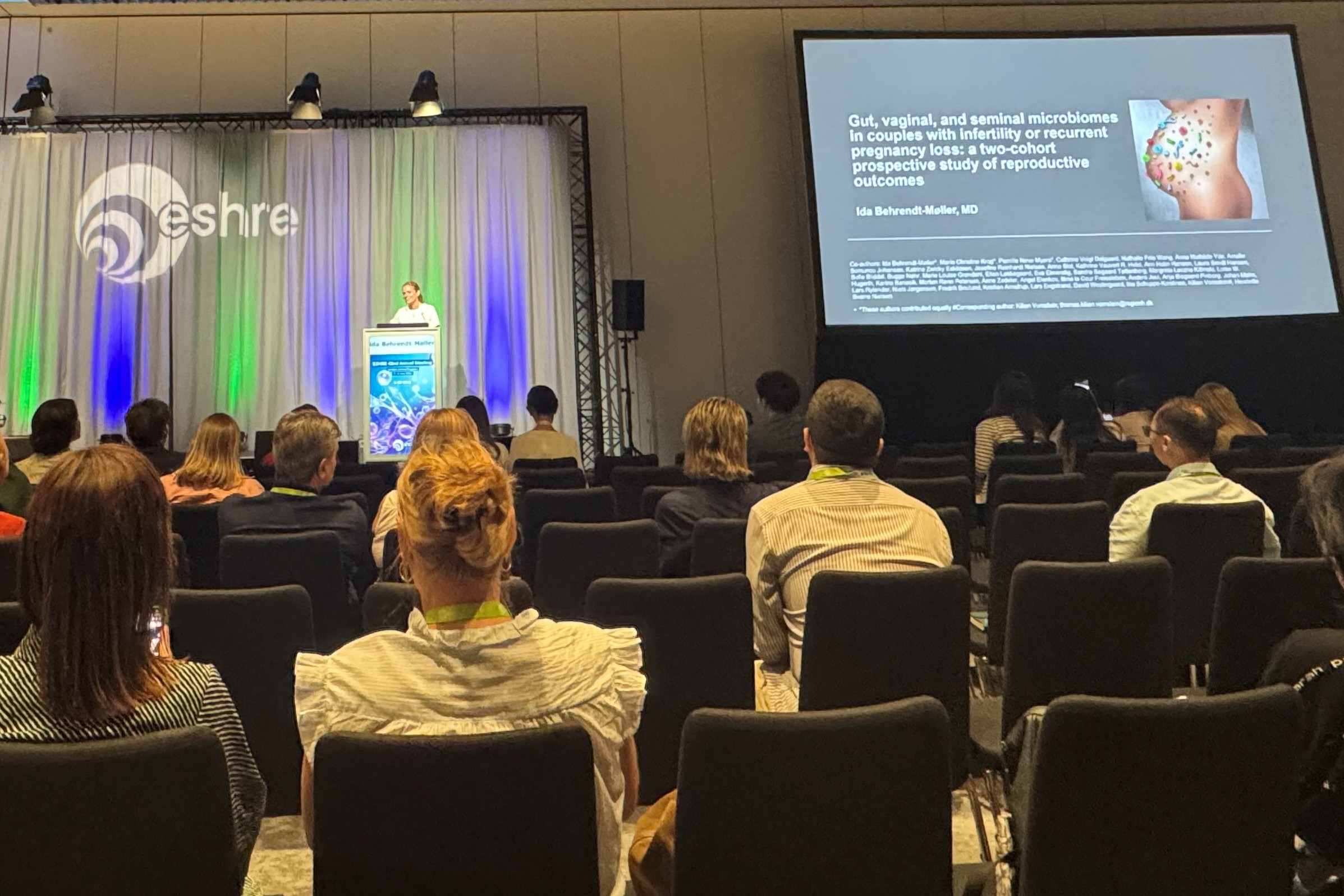
The research sheds new light on how the gut and seminal microbiomes may influence fertility, pregnancy loss, and the likelihood of having a baby. The study is based on the ReproUnion Biobank & Infertility Cohort (RUBIC), as well as the Microbiome in Recurrent Pregnancy Loss cohort (Mi-RPL), and it was published in The Lancet Obstetrics, Gynaecology, & Women’s Health on 4 August 2026.
PhD student and clinical-researcher Ida Behrendt-Møller presented the study at ESHRE 2026 in London, where it attracted considerable attention and it was also covered by media in both the UK and Spain.
The study explores how microbial imbalances in both partners may affect reproductive outcomes. The findings mark an important shift in reproductive microbiome research by moving beyond a sole focus on women and instead examining fertility from a true couple perspective.
“For too long, infertility research has largely examined women and men separately. With RUBIC, we can study both partners together and understand fertility as it occurs in real life. This gives us a more complete picture of the biological factors that influence conception, pregnancy loss and live birth, and can help uncover new mechanisms that may lead to more precise diagnostics and treatment in the future,” comments Professor Henriette Svarre Nielsen, senior author of the study and also member of the ReproUnion Executive Board.
Looking beyond the woman alone
For many years, reproductive microbiome research has concentrated primarily on the vaginal microbiome. However, the new study demonstrates that microbial imbalances in men’s seminal microbiome and the female gut may be more strongly associated with reproductive outcomes than previously recognised.
The researchers found that a seminal microbiome resembling patterns seen in vaginal dysbiosis was associated with reduced chances of live birth and a 2.6-fold higher risk of pregnancy loss. Gut dysbiosis in women was associated with impaired conception, while vaginal dysbiosis alone showed no clear association with reproductive outcomes in the studied cohorts.
“The findings highlight the importance of studying fertility and pregnancy loss as a shared challenge affecting both partners,” comments Henriette Svarre Nielsen.
RUBIC provides a unique foundation
A key strength of the study is its use of data and biological samples from RUBIC, ReproUnion’s binational biobank and infertility cohort spanning Denmark and Sweden. What makes RUBIC unique internationally is its couple-based design, where information and biological samples are collected from both partners.
According to Henriette Svarre Nielsen, this type of research would not have been possible without long-term investments in collaborative research infrastructure: “This publication demonstrates the value of RUBIC and underlines how the building of large biobanks and longitudinal cohorts is worth waiting for. The couple-based approach is now revealing new biological mechanisms that may otherwise have remained hidden and it is exactly the kind of knowledge RUBIC was established to support.”
The study included couples undergoing fertility treatment through RUBIC as well as couples with recurrent pregnancy loss enrolled in the Mi-RPL cohort. Together, the two cohorts enabled researchers to examine reproductive outcomes across different patient groups and clinical pathways.
New opportunities for future diagnostics
While the researchers stress that the findings show associations rather than causation, the study points towards potentially modifiable factors that could eventually lead to new diagnostic tools or targeted interventions.
By analysing vaginal, gut, and seminal microbiomes together, and by including both partners in the investigation, the research opens new avenues for understanding why some couples struggle to achieve or sustain pregnancy despite the absence of obvious clinical explanations.
For ReproUnion, the publication is also an important example of how investments in shared Nordic research infrastructure continue to generate internationally recognised research and contribute to advancing reproductive health.
🔗 The Lancet Obstetrics, Gynaecology, & Women’s Health:
Gut, vaginal, and seminal microbiomes in couples with infertility or recurrent pregnancy loss: a two-cohort prospective study of reproductive outcomes.