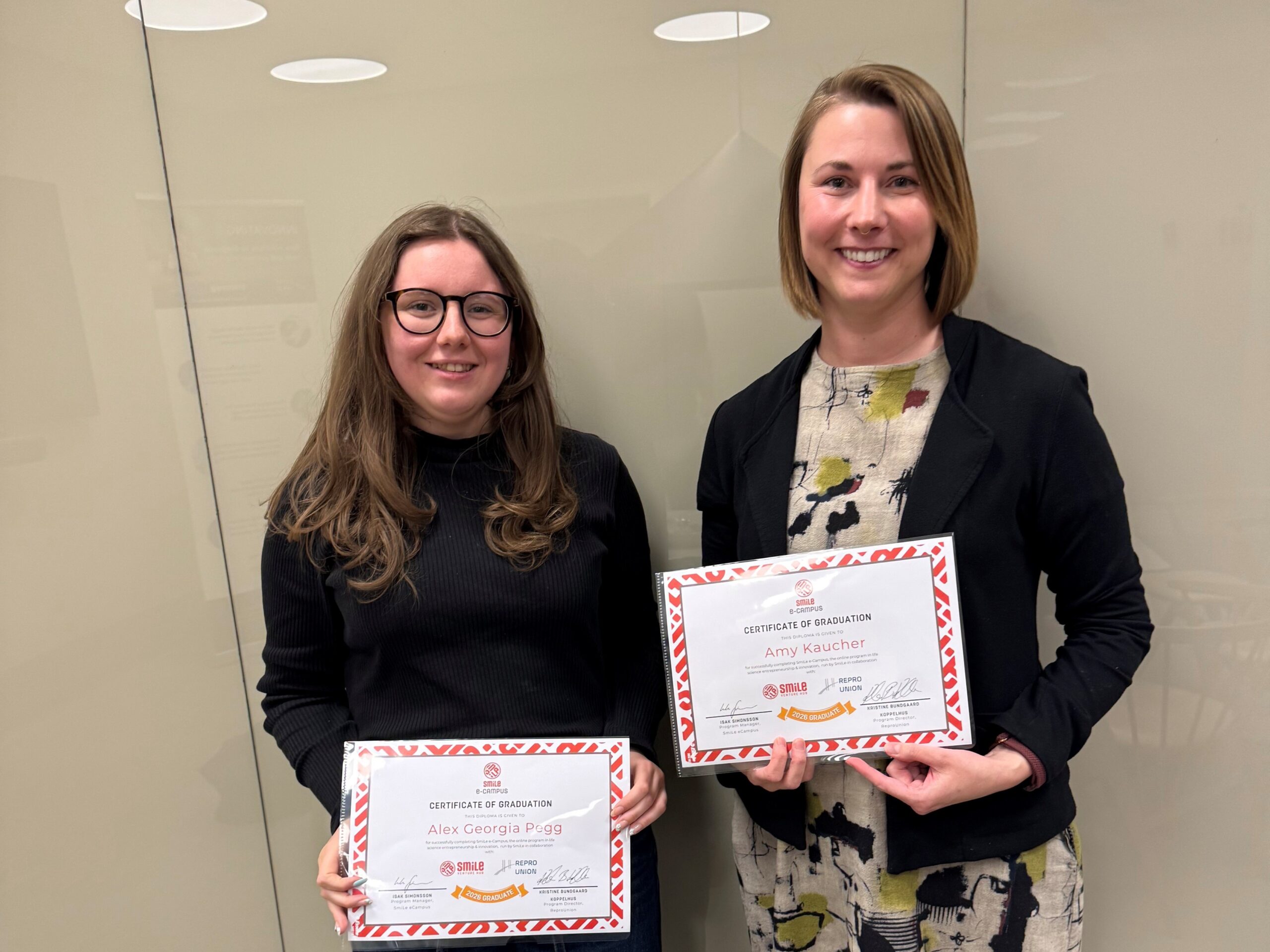
On 16 June 2026, ReproUnion and SmiLe Venture Hub celebrated two new graduates from the SmiLe Academy – a tailored version of the SmiLe eCampus programme designed specifically to strengthen innovation in reproductive medicine in the Øresund region.
The programme builds on SmiLe’s well-established digital training format, equipping participants with the essential skills needed to navigate the complex path from idea to market, including regulatory strategy, business development, financing, and pitching.
During the final session, the graduates presented their innovation concepts, demonstrating both scientific insight and a strong understanding of the broader innovation landscape.
Alex Pegg presented a novel system aimed at reducing the loss of oocytes during laboratory handling – helping ensure that every egg sample can be used and protected in a closed system. The concept addresses a critical challenge in fertility laboratories, supporting both clinical outcomes and research efficiency.
Amy Kaucher presented a systems-level approach to earlier detection of accelerated ovarian ageing. Her concept focused on improving the identification of women at risk before fertility treatment outcomes begin to decline – highlighting the potential for earlier intervention and more effective care pathways.
Expert feedback and reflections
The presentations were reviewed by experienced external experts, including Rita Lobo from Ferring Pharmaceuticals and Thomas Unt from SmiLe Venture Hub, who provided valuable feedback and industry perspectives, including the importance of recognising the diversity of innovation pathways.
Feedback emphasised critical factors such as regulatory pathways, route to market, and the need to clearly articulate the value proposition – whether in terms of clinical impact, operational efficiency, or scalability.
Both graduates highlighted the value of the programme in shaping their ideas and strengthening their approach to innovation: “I liked the structure of the programme and how it guided us through the different aspects of developing an idea. The feedback I received – both on the viability and the future possibilities of my concept – was especially valuable in helping me refine my approach,” commented Alex Pegg, PhD fellow at the department of cellular and molecular medicine at the University of Copenhagen.
Amy Kaucher, who is postdoc in the same department, further reflected:
“Working on a more health policy-driven idea in a programme largely focused on venture and investment perspectives was both challenging and rewarding. It made it harder to clearly demonstrate ROI, and other choices might have made that easier – but I really valued the feedback, especially the perspective that the idea could also be developed into a product.”
On behalf of ReproUnion, Project Director, Kristine Koppelhus commented:
“The ReproUnion partnership is pleased to support early development of new solutions that can address unmet needs – from laboratory technologies to system-level interventions. We would like to congratulate this year’s graduates who follow the nine participants completing the programme in 2025. We look forward to following all their continued journeys from idea to impact.”