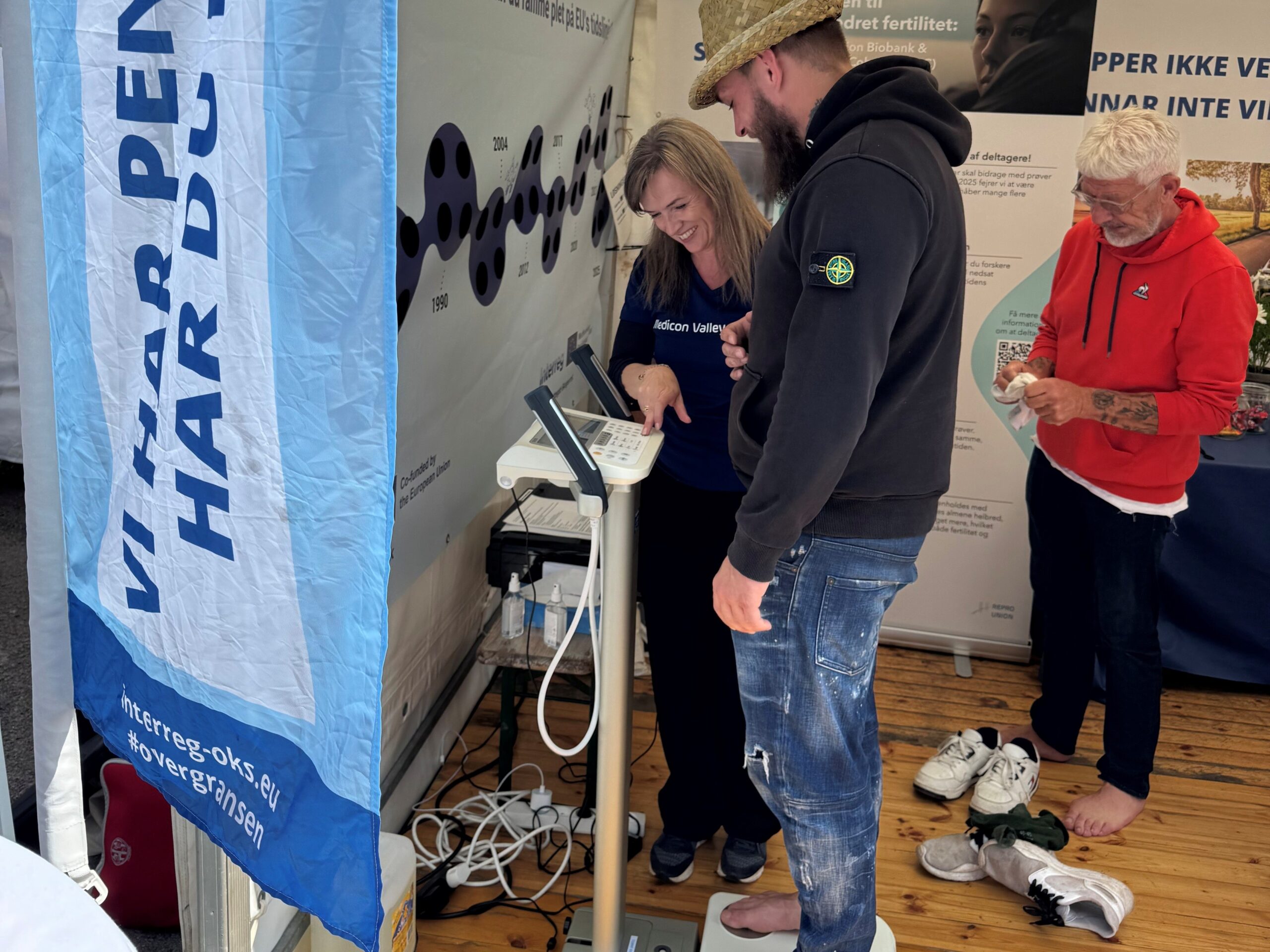
On 11 June, ReproUnion joined Folkemødet on Bornholm – Denmark’s annual democracy festival, where citizens, researchers, policymakers and organisations come together to exchange ideas and engage in dialogue.
With around 3,800 events taking place over three days, the festival once again highlighted the breadth of societal topics – from health and innovation to climate, equality and democracy.
Infertility affects approximately 1 in 6 couples, with male factors contributing to around half of all cases. At Folkemødet, it became clear that this is a topic people are ready to discuss – and one they can often relate to.
Strengthening the conversation on male fertility
ReproUnion’s event “Kom tæt på mandlig fertilitet – forskning og nye værktøjer” was among the first on the programme. Hosted in the Interreg Öresund-Kattegat-Skagerrak tent, the event focused on male fertility in an informal setting. Visitors could try out a body composition analyser, which sparked conversations about body composition, fat- and muscle mass in relation to fertility.
ReproUnion was pleased to be joined by Tore Duvold, CEO of Spermosens AB, who presented the company’s JUNO-Checked technology. This approach focuses on measuring the sperm’s ability to bind to the egg, which offers a functional assessment of male fertility and supports improved clinical decision-making.
The interest from a broad audience highlighted both the need for better diagnostics and a willingness among the public to understand male fertility more deeply. Engagement included talks with students who researched male fertility for an assignment, as well as with couples experiencing fertility challenges themselves. This shows how cross-border projects like ReproUnion not only address research and innovation, but also create space for open, honest conversations about fertility in real-life contexts.
A strong programme on male fertility and women’s health
ReproUnion’s participation was part of a broader programme at Folkemødet that put fertility and reproductive health on the agenda.
Among the many relevant events were discussions hosted by the University of Copenhagen, including “Forskning i kvinders sundhed – fra blind vinkel til ny viden”, which addressed differences in men’s and women’s health, the need for new research efforts, and how new knowledge can be translated into improved treatment and prevention. Panelists included member of Parliament, Stinus Lindgreen; Professor and Prorector Eva Hoffmann and Professor and Executive Board member of ReproUnion, Henriette Svarre Nielsen.
Another key debate, “Sædkrise – hvem har ansvaret for fremtidens fertilitet?” discussed whether poor semen quality in men is an overlooked societal issue. Among the four panelists were Professor Kristian Almstrup and member of parliament Lea Wermelin.
Together, these events point to a growing recognition that fertility is not only a clinical challenge but also a societal one and calls for continued cross-disciplinary collaboration and long-term commitment.
Folkemødet’s unique format brings decision-makers and citizens together in informal settings and makes it an ideal platform for advancing important conversations. As part of ReproUnion’s ongoing work we look forward to continuing the dialogue about infertility – and the need to broaden the conversation beyond treatment alone.