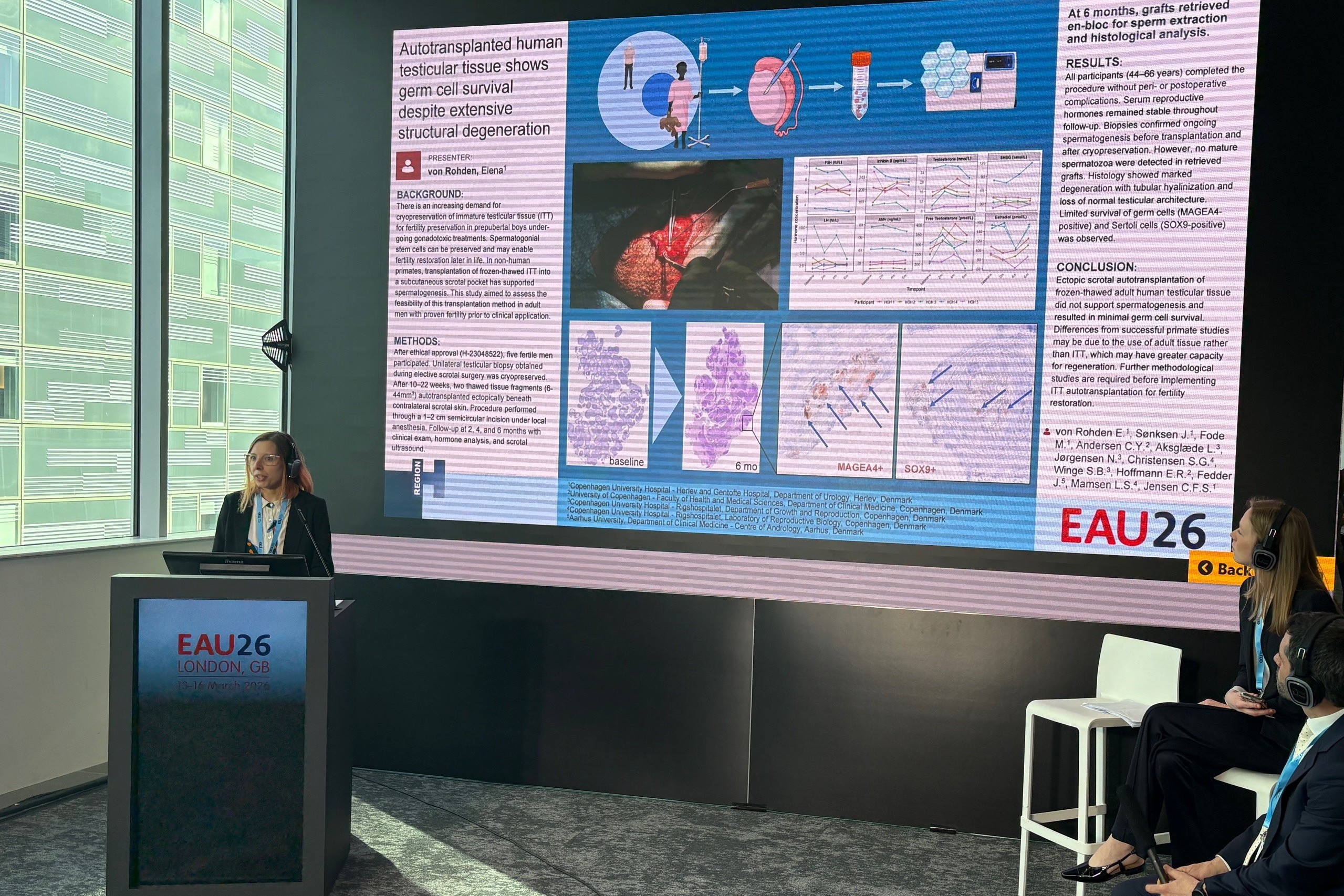
Findings presented at the EAU Congress last week highlight both the potential and the current limitations of restoring male fertility using cryopreserved testicular tissue. They also underline the continued need for new treatments, an area where ReproUnion has contributed for more than a decade.
At the European Association of Urology (EAU) Congress 2026 in London, Elena von Rohden, MD and PhD student, presented new clinical findings from DFF-supported research, exploring fertility restoration using autotransplanted human testicular tissue.
The study, “Autotransplanted human testicular tissue shows germ cell survival despite extensive structural degeneration”, adds important new knowledge to an area with a significant unmet medical need: male infertility. The abstract will be published in a supplement to the upcoming issue of European Urology.
Male infertility plays a role in approximately half of all infertility cases, yet treatment options remain limited – particularly for men with non obstructive azoospermia and for boys who undergo gonadotoxic cancer treatment before puberty.
“For many of these patients, there are currently no clinically proven options to restore fertility later in life,” says Elena von Rohden, adding: “Our research helps clarify what is biologically possible today – and, just as importantly, what still needs to be improved before these methods can be translated into clinical treatments.”
From fertility preservation to future treatment options
Worldwide, more than 3,000 prepubertal boys have had immature testicular tissue cryopreserved prior to cancer treatment. While spermatogonial stem cells are known to survive cryopreservation, turning preserved tissue into functional fertility remains a major scientific challenge.
In the study presented at EAU26, cryopreserved adult human testicular tissue was autotransplanted ectopically in fertile men to assess feasibility, safety and biological outcomes. Transplanted testicular tissue could not sustain full spermatogenesis and showed widespread structural degeneration, but isolated survival of germ cells and Sertoli cells was observed, providing valuable insight for optimizing future strategies.
“These findings show both the complexity and the potential of testicular tissue transplantation – and demonstrate why continued research and innovation are essential if we want to develop real treatment options for infertile men,” says Christian Fuglesang S. Jensen, group leader at Herlev- and Gentofte Hospital and Principal Investigator of the research project.
Built on long-term research and innovation in ReproUnion
The EAU presentation builds directly on research that received DKK 2 million from the Independent Research Fund Denmark (DFF) in 2022 and has helped establish the scientific foundation for today’s development of stem cell–based techniques toward restoring male fertility.
Since 2023, the research has also been closely linked to a ReproUnion Innovation Project, which focuses on developing new solutions for male fertility restoration and strengthening the translation of advanced reproductive research into future clinical and technological innovations.
“ReproUnion has worked strategically with male fertility for many years – from basic research to clinical studies and innovation. Having a strong innovation framework is crucial if new knowledge is to move beyond the laboratory and eventually benefit patients,” concludes Christian Fuglesang S. Jensen.
While further refinement is needed before testicular tissue autotransplantation can be applied clinically, the findings presented at this 41st Annual EAU Congress represent another important step toward expanding treatment options for men affected by infertility.