ReproUnion has published a new collaboration case highlighting how the Swedish company Spermosens has clinically validated its functional male fertility diagnostic, JUNO-Checked, at the Reproductive Medicine Center (RMC) in Malmö.
The case documents how facilitated access to clinical expertise, infrastructure and patient pathways within the ReproUnion ecosystem has supported Spermosens in generating proof-of-concept data in a real IVF setting – an important step toward implementation in routine fertility care.
Male factor infertility contributes to almost half of all infertility cases, yet diagnostic tools remain limited. By measuring the biological interaction between sperm and egg, the JUNO technology represents a new functional approach to assessing sperm fertilization potential.
“Our first clinical study conducted at RMC Malmö has demonstrated a statistically significant correlation between sperm binding capacity and fertilization rates. And with an upcoming study we will now also validate how JUNO-Checked can deliver results much faster, which makes the technology compatible with clinical workflows,” explains Tore Duvold, CEO at Spermosens.
Strengthening male diagnostics to support better treatment decisions
More precise functional diagnostics may for example help clinicians differentiate earlier between conventional IVF and ICSI* treatment strategies. This could reduce uncertainty in treatment planning and potentially spare couples from unnecessary cycles.
“JUNO-Checked is the first functional test that reflects the sperm’s biological ability to interact with the egg,” underlines Tore Duvold, CEO of Spermosens. “By providing clearer guidance to clinicians, we aim to help couples get the right treatment sooner.”
Improving diagnostics for male infertility also contributes to a more balanced and evidence-based approach to fertility care, reflecting the growing recognition that women’s and men’s reproductive health are closely interconnected.
Featured as part of the ReproUnion innovation story
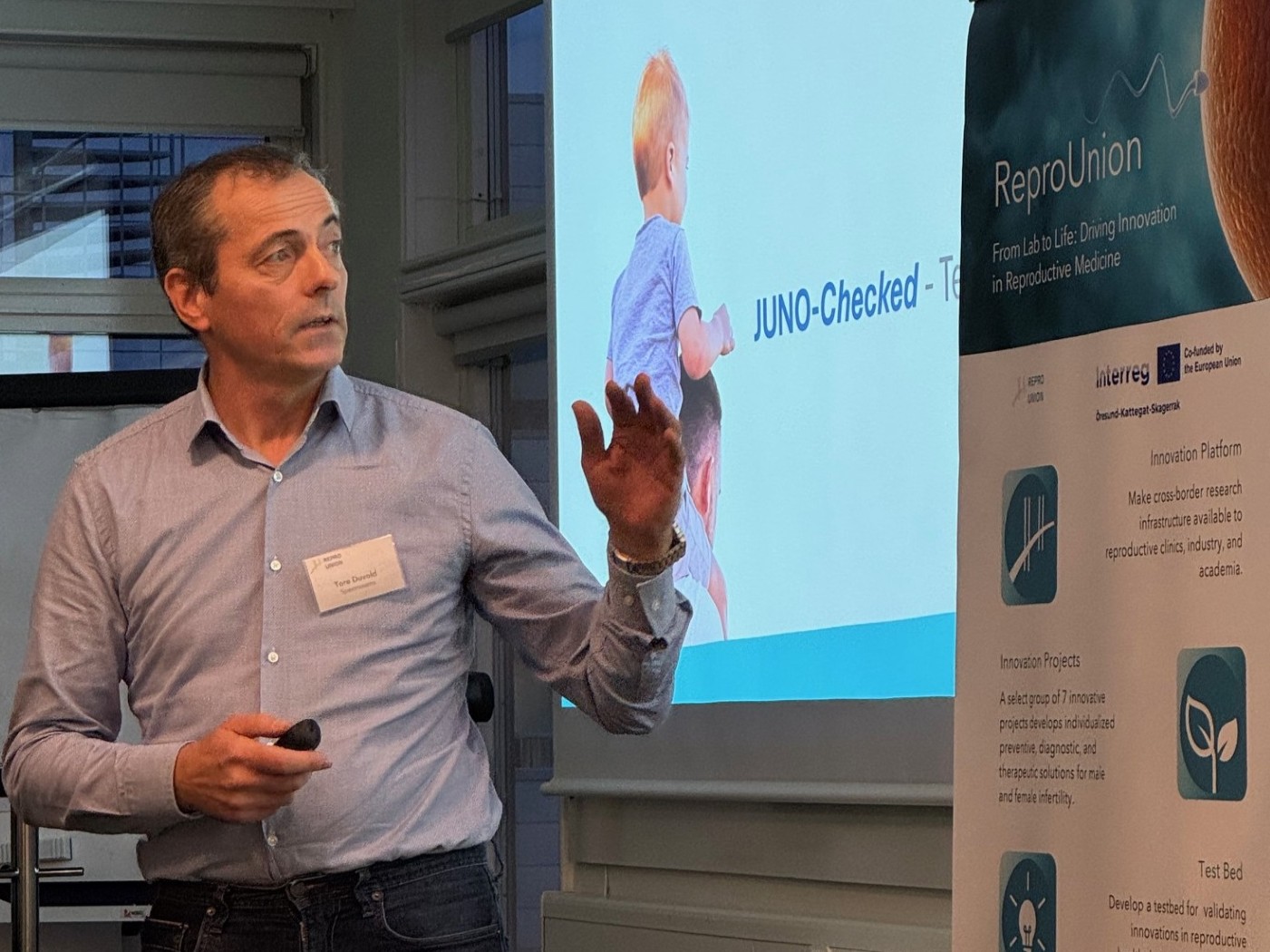
Spermosens recently presented its journey at ReproUnion’s Prototype the Future of Fertility Innovation event, where startups, clinicians and industry partners discussed how to accelerate solutions for tomorrow’s reproductive healthcare.
The company’s development pathway – from molecular insight to clinical validation – illustrates how structured collaboration between innovators and clinical environments can help translate promising science into validated solutions.
The new case is part of ReproUnion’s ongoing work to document and showcase how translational collaboration supports innovation in reproductive health.
👉 Read the full case here: Moving male fertility diagnostics closer to the market with clinical validation at RMC Malmö
*In vitro fertilisation(IVF) vs Intracytoplasmic sperm injection (ICSI):
IVF involves placing eggs and sperm together in a laboratory dish and allowing fertilisation to occur naturally. In ICSI, an embryologist injects a single sperm directly into the egg to achieve fertilisation, often used in cases of male infertility.